Text 01 · Prague · 8 September 2026
How many parking spaces Prague lost to bigger cars
About 2 745 stalls since 2012, 1.6 % of the paid zones. Smaller than the headlines, and for reasons that are more interesting than the number.
- stalls lost 2012–2025
- 2 745 1 946 – 8 058 across all assumptions
- share of paid-zone capacity
- 1.6 % 1.1 – 4.6 %
- roadway taken by wider cars
- 2.76 ha not counted as parking anywhere
- price of a resident permit
- 89 Kč / m² / year Fabia or Kodiaq, same price
Cars are getting bigger. Everyone can see it, Transport & Environment has measured it4, and the obvious next sentence is that they must be eating the parking. The question this text asks is how much, for one city, from the city's own data. The answer is less than the thesis of "carspreading" would suggest, and the reason it is less is the useful part.
Prague's paid parking zones are published as 16 874 polygons on the city's ArcGIS server1, each with an area in real square metres (the server runs in S-JTSK, so nothing needs reprojecting; the ArcGIS Online copy in Web Mercator overstates every area by a factor of 2.43 at Prague's latitude, which is a trap worth naming). Summed, the zones hold 168 456 stalls, which is 1.4 % above the figure the city's road authority published for December 20242, in the right direction: capacity has been added since. Two independent server aggregations, by zone type and by district, agree on the total area to 0.0 m².
Why the answer is a length, not an area
The natural calculation is area divided by footprint: take the zone area, divide by the outline of a car plus a manoeuvring gap, and see how many fewer cars fit today than in 2012. It gives 5 600 to 10 800 lost stalls, and it is wrong for most of Prague, because most of Prague parks parallel to the kerb.
On a kerb, capacity is length divided by pitch, where pitch is the car's length plus the gap. Width does not enter the formula at all. A car that is 1.90 m wide instead of 1.75 m does not push its neighbour out, because its neighbours are behind and in front of it. It takes the extra width from the driving lane, which is a real cost, but a different one. The area model books that lane as lost parking. The difference between 2 745 and 8 237 stalls is not a data problem; it is a question problem.
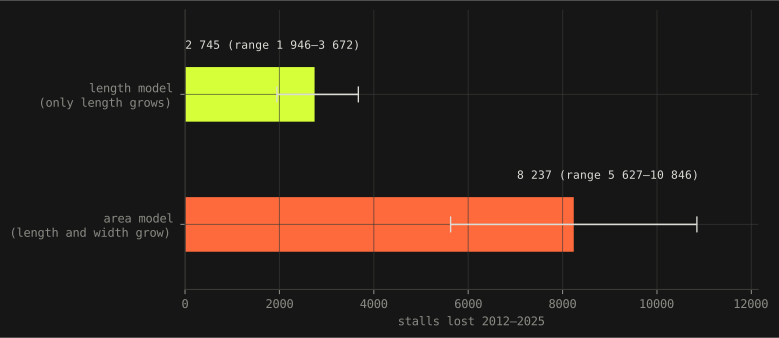
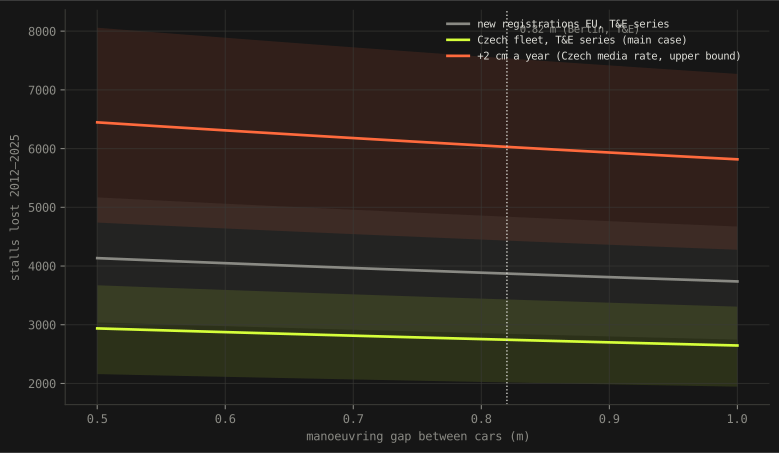
The length model needs no kerb length, which is fortunate because the server would not give it: with the kerb held constant, stalls in 2012 equal stalls today times the ratio of the two pitches. Today's count is the anchor. The gap is 0.82 m, not chosen by hand: T&E reports a 5.20 m pitch for 2025 from Berlin traffic data and a 4.38 m car4, and the difference lands in the middle of the 0.5 to 1.0 m range the brief asked to test.
The street is parked by the fleet, not by the showroom
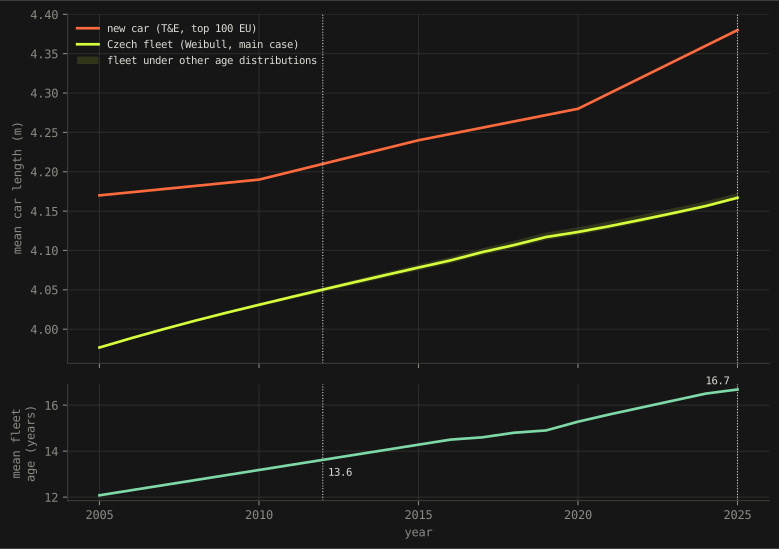
The second correction is bigger than the first. New cars in the EU's top 100 grew 17 cm in length between 2012 and 20254. But the cars on Prague's streets are not new cars; they are the fleet, and the Czech fleet aged from 13.6 to 16.7 years over the same period8. Weighting each model year by a survival curve and calibrating to that mean age, the average parked car grew 11.7 cm, not 17. The ageing fleet absorbed about a third of the growth. The shape of the age distribution (Weibull, exponential, uniform) moves this by hundredths of a centimetre; the model does not care.
Put together: 11.7 cm more car at a 0.82 m gap, on the 68 % of stalls that T&E assumes are parallel4 (a Berlin figure, the largest single uncertainty here), and Prague's current zones would hold 2 745 more cars if they were parked by 2012's fleet. That is 1.6 % of capacity. Over the full grid of assumptions the range is 1 946 to 8 058 stalls, and the top of the range only appears with the 2 cm-a-year growth rate quoted in Czech media and attributed to the car importers' association, for which no primary source could be found9; T&E's own rate is 1.2 cm a year5.
Where the width went
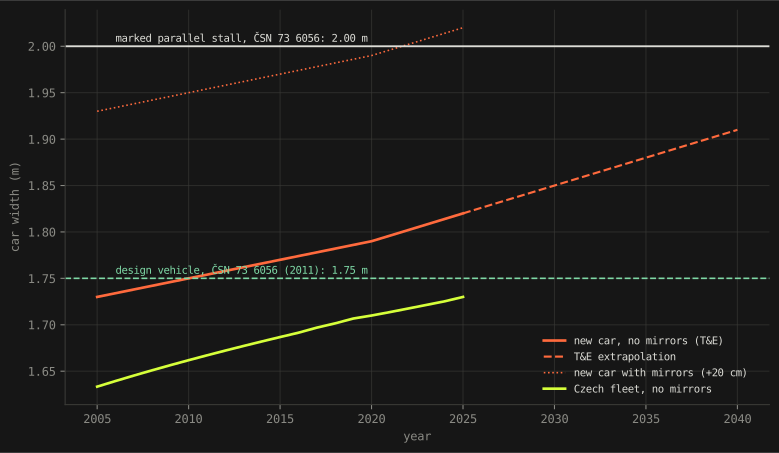
Cars in the zones are 5.8 cm wider than in 2012. On parallel stalls that is 27 598 m², 2.76 hectares of roadway, the area of roughly 2 000 of today's stalls, and it appears in no parking statistic because it was never parking. It came out of the driving lane.
The more graphic number: an average new car with mirrors folded out is 2.02 m wide (T&E measures width without mirrors, per SAE J110010; mirrors add 15–25 cm, 20 used here11). The marked parallel stall in the Czech standard ČSN 73 6056 is 2.00 m7. New cars crossed that line around 2022. The standard's own design vehicle, from 2011, is 1.75 m wide; new cars had outgrown it before the standard was published.
The price does not know any of this
A resident permit costs 1 200 Kč a year3. At 13.5 m² of net zone area per stall, that is 89 Kč per square metre per year, whether the car is a Fabia or a Kodiaq. The price rations neither the number of cars nor their size. This part of the thesis survives the data intact, and it is stronger than the capacity part.
What was checked, and what was not
Things that passed: 27 model tests, including the agreement of the continuous formula with a Monte Carlo over the real distribution of segment sizes (16 784 segments, median 8 stalls; integer effects add 0.12 percentage points, not more); the stall totals against the road authority's published numbers2; district-level geometry, which turned out uniform, 13.7 to 16.0 m² per stall, so no Simpson's paradox hides two opposite cities inside one mean.
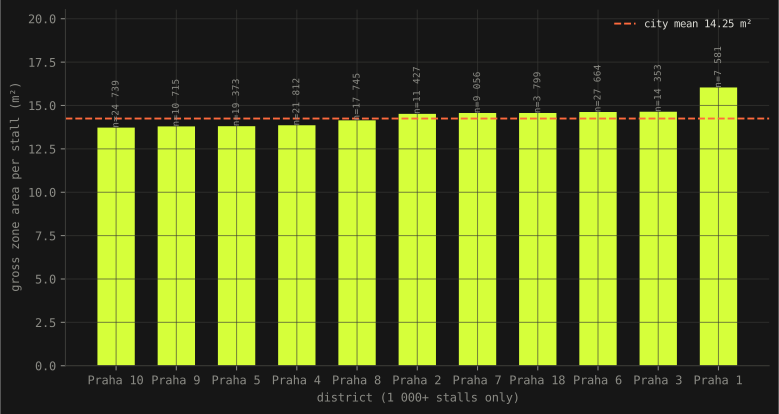
Things that did not: T&E's headline that European cities lose 8.5 to 14 % of parallel parking by 20404 could not be reproduced from T&E's own published parameters, which give 3.4 to 4.0 %. The factor of two to four is unexplained, so the headline is cited here as their modelling, not as a check on this one. Also unverified: the share of parallel stalls in Prague (the answer sits in the polygons' shape, width 2 to 2.5 m means parallel, 4.5 to 5.5 m means perpendicular, and needs the individual features rather than aggregates); car dimensions for cars registered in Czechia rather than the EU top 100 (one Czech data point, 111 models in 20196, sits 1.4 cm wider and 2.8 cm longer than the EU series, so the transfer is defensible, but it is a transfer); and the age structure of Prague's fleet specifically, which is probably younger than the national fleet.
One phrasing to be careful with. "Prague lost 2 745 stalls" is shorthand. The model does not know how many stalls Prague had in 2012; it holds today's kerb constant and asks how many 2012 cars it would take. The precise sentence is: on today's zone area, 2012's fleet would park 2 745 more cars.
References
- Hlavní město Praha, ArcGIS Server: zóny placeného stání — úseky (MapServer/3), tarifní zóny (MapServer/10), vyhrazená, ZTP a zásobovací stání (placene_parkovani). Server-side aggregations, snapshot 8 September 2026. Coordinate system S-JTSK (EPSG 5514).
- TSK Praha via data.praha.eu: Počty parkovacích míst v Praze, December 2024: 101 908 resident, 63 117 mixed, 1 155 visitor stalls.
- TSK Praha: Parking (zone management, permit prices; the "177 thousand stalls" figure without date or breakdown).
- Transport & Environment (2026): Ever-bigger? Car size at a crossroads, p. 26. Dimension series for the 100 best-selling EU models, width without mirrors; 5.20 m end-to-end pitch (Berlin Traffic Information Centre, 2025); 68 % parallel share (Berlin); 8.5–14 % loss projection to 2040.
- Transport & Environment: Carspreading to wipe out up to 14 % of on-street parking in European cities (annual growth rates: 1.2 cm length, 0.5 cm width).
- Závadská, A. (2020): Optimalizace návrhových prvků ČSN 73 6056, VUT Brno. Weighted mean of the 111 best-selling new cars in Czechia, 1–11/2019 (205 994 units): 1.80 × 4.30 m.
- ČSN 73 6056 (March 2011), Odstavné a parkovací plochy silničních vozidel. The standard is paywalled; stall dimensions (parallel 2.00 × 5.75 m, perpendicular 2.50 × 5.00 m) and the 1.75 m design vehicle are taken from secondary sources, chiefly [6], which disagree on the parallel stall length (5.50–6.75 m by source and variant). The length model does not depend on them; the width claim does.
- Mean age of the Czech passenger-car fleet: ČAPPO, Stav vozového parku v ČR (compilation of SDA data); ČSÚ, Auta na českých silnicích; MD ČR, Osobní automobily registrované v ČR. Distribution by model year is not published; modelled (Weibull, exponential, uniform) and calibrated to the published means, 13.62 (2012) and 16.68 (2025).
- "2 cm a year" appears in Czech media (iROZHLAS) attributed to SDA data; no primary SDA publication of that rate was found, so it enters only as the upper bound.
- SAE J1100 Motor Vehicle Dimensions, W103: overall width excluding mirrors.
- Mirror allowance 15–25 cm: Car width explained: body, mirrors folded, mirrors out (drivesize.com).
- Not used, relevant for the next step: EEA Discodata CO2 monitoring (wheelbase and track for cars registered in CZ); Canadian Vehicle Specifications (length, wheelbase and track together, for calibrating the conversions); Holder, D. (2021), Systematic analysis of changing vehicle exterior dimensions, ICED21, 10.1017/pds.2021.553 (wheelbase/length 0.618, R² 0.75); Registr silničních vozidel data cube.